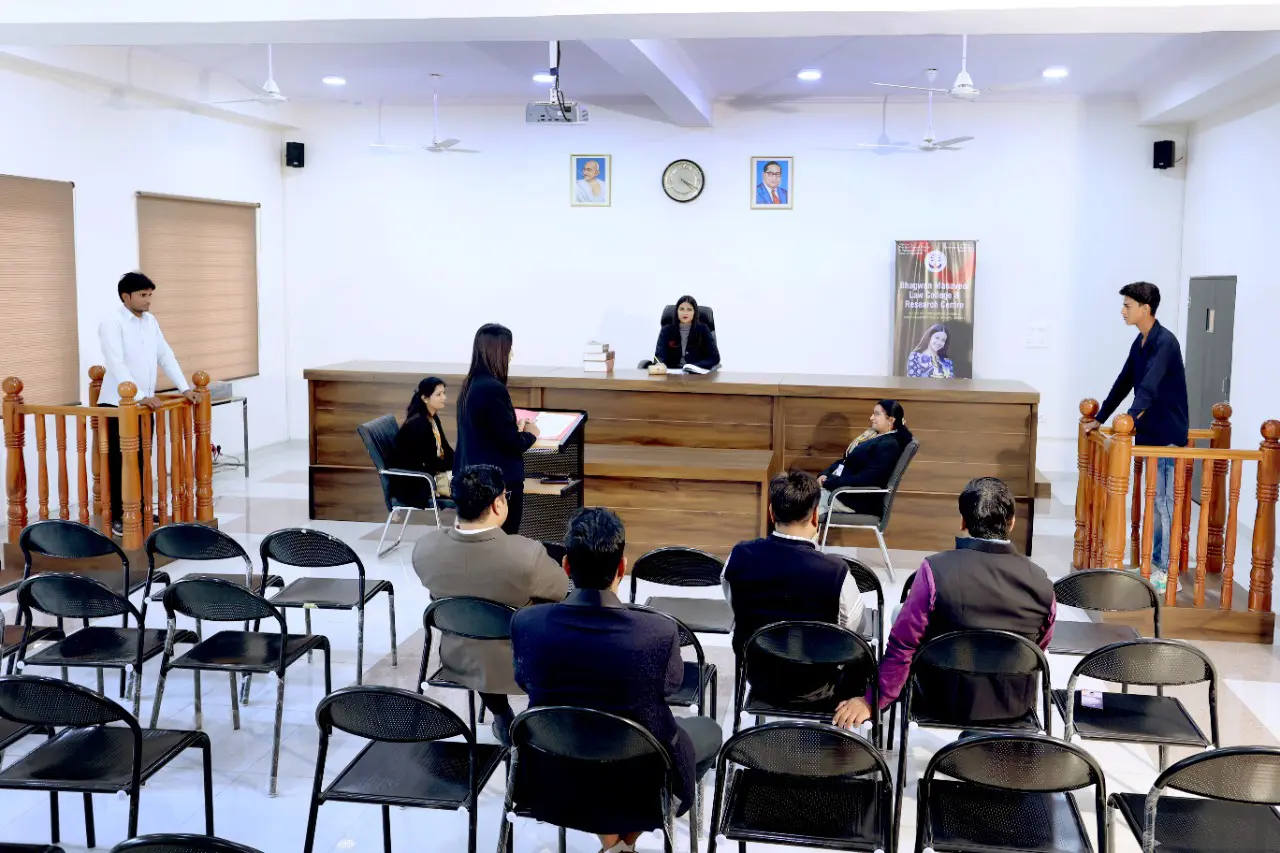
Law school is not merely a classroom experience. It is a training ground where students learn to think like lawyers, argue like advocates, research like scholars, and gradually understand how the legal profession actually functions. But with lectures, assignments, examinations, moot court competitions, internships, seminars, research projects and extracurricular responsibilities competing for attention, one question frequently troubles law students:
How do I do justice to everything without feeling constantly overwhelmed?
The answer does not lie in trying to do everything simultaneously. It lies in learning how to balance, prioritise and integrate different dimensions of legal education. For students pursuing their degree in one of the many law colleges in Jaipur Rajasthan, this balance can become particularly important. A student who attends classes regularly but never explores practical legal work may lack professional exposure. Another who spends all their time competing in moots and internships but neglects academic fundamentals may struggle to develop the conceptual depth expected from a law graduate. A meaningful legal education lies somewhere between these extremes.
LAW SCHOOL IS A THREE-DIMENSIONAL LEARNING EXPERIENCE
It is useful to think of legal education as a three-part structure.
EFFECTIVE LEGAL EDUCATION
▲
│
┌────────────────┼────────────────┐
│ │ │
▼ ▼ ▼
ACADEMICS MOOT COURTS INTERNSHIPS
│ │ │
Legal knowledge Advocacy & Professional
& conceptual research skills exposure
understanding │ │
└────────────────┼────────────────┘
▼
PROFESSIONAL READINESS
Academics provide the foundation. Moot courts develop application. Internships provide exposure to the profession. These are not competing components of law school. Ideally, they should reinforce one another.
A constitutional law lecture may help a student understand a moot proposition. Research undertaken for a moot may deepen their understanding of a legal principle discussed in class. An issue encountered during an internship may encourage the student to return to a statute or judgment with an entirely different perspective. This is where law school becomes intellectually rewarding: when classroom learning begins to connect with the real world.
DO NOT CONFUSE BEING BUSY WITH BEING PRODUCTIVE
One of the biggest challenges faced by law students is the pressure to remain constantly occupied. There is always another competition, another certificate, another webinar, another internship and another committee activity. But a long list of activities does not automatically translate into meaningful professional development. A student who completes six internships without understanding what they learned from them may gain less than someone who completes two carefully selected internships and actively reflects on the experience. Similarly, participating in several moot competitions is valuable only when students genuinely engage with legal research, drafting and oral advocacy.
The better question is not: “How many things am I doing?” It is: “What am I learning from what I am doing?”
That shift in perspective can completely change the way students approach law school.
BUILD YOUR ACADEMIC FOUNDATION FIRST
No amount of extracurricular activity can compensate for weak legal fundamentals. Students should therefore treat classroom learning as a continuing process rather than something reserved for examination week. Reading the bare Act, understanding important judgments, following recent legal developments and revisiting difficult concepts regularly can make academic preparation considerably easier. Instead of waiting for examinations to begin studying an entire syllabus, students can adopt a simple habit:
Class → Reading → Case Law → Revision → Application
For instance, after studying Article 21, a student can read the relevant judgments, identify how judicial interpretation has evolved, and then consider how the principle applies to contemporary legal issues. This method takes relatively little additional time but produces much deeper learning. For institutions aspiring to provide the best legal education in Jaipur, encouraging this connection between classroom teaching, case-law analysis and practical application should be an essential part of the learning environment.
TREAT MOOT COURT AS A LABORATORY FOR LEGAL SKILLS
A moot court competition is not simply an opportunity to wear formal attire and argue before a panel. It is a miniature simulation of professional legal practice. Students learn how to dissect facts, identify issues, locate authorities, interpret statutes, distinguish precedents and construct persuasive submissions. But moot preparation can consume enormous amounts of time if it is not organised properly.
A useful preparation cycle is:
UNDERSTAND THE PROPOSITION
↓
IDENTIFY ISSUES
↓
CONDUCT RESEARCH
↓
DEVELOP ARGUMENTS
↓
DRAFT MEMORIAL
↓
REBUTTAL & REVIEW
↓
ORAL ARGUMENTS
↓
MOCK MOOTING
The most effective teams do not leave everything until the last few days.
CHOOSE INTERNSHIPS FOR LEARNING, NOT JUST CERTIFICATES
Internships are another important part of legal education, but students often approach them with the wrong objective.
The question should not be: “Where can I get the most impressive certificate?” It should be: “Where can I gain meaningful exposure to the kind of work I may want to pursue?”
A student interested in litigation may benefit from spending time with an advocate, observing proceedings and learning how pleadings and applications are drafted. A student attracted to corporate practice may gain more from exposure to contracts, compliance, due diligence and corporate documentation. Someone interested in constitutional or public law may prefer research organisations, chambers, legal aid institutions or policy-oriented work. Internships should also evolve as the student progresses through law school. Early internships can be exploratory. Later internships should increasingly reflect a student's emerging interests.
Keeping a simple internship journal can be extremely useful. After each internship, record:
- What legal work did I observe?
- What drafting skills did I develop?
- Which laws or judgments did I encounter?
- What professional skill did I improve?
- Did this area of law interest me?
By the end of the degree, these reflections can help students make far more informed career decisions.
LEARN THE ART OF SAYING “NOT NOW”
Balance sometimes requires students to say no. This does not mean refusing opportunities. It means recognising that every opportunity has an opportunity cost. If examinations are approaching and a student accepts another major extracurricular responsibility, something else will inevitably receive less attention. A simple priority matrix can help:
|
Priority |
What to Do |
|
Examination next week |
Give immediate academic attention |
|
Moot competition next month |
Schedule consistent preparation |
|
Internship assignment due tomorrow |
Complete it first |
|
Optional webinar |
Attend only if time permits |
Students should learn to distinguish between an opportunity that is genuinely valuable and an activity that merely adds another line to a résumé.
A PRACTICAL WEEKLY MODEL FOR LAW STUDENTS
There is no universal timetable that works for every student. However, a flexible weekly structure can provide direction.
YOUR WEEK
│
┌─────────────┼─────────────┐
▼ ▼ ▼
CLASSES PRACTICAL PERSONAL
│ EXPOSURE │
▼ │ ▼
Reading Moot/Intern Rest & Health
│ │
└───────┬─────┘
▼
WEEKLY REVIEW
│
▼
NEXT WEEK'S PLAN
At the end of each week, spend fifteen minutes asking:
- What did I learn academically?
- What practical skill did I develop?
- What remains incomplete?
- What deserves priority next week?
This small habit can prevent academic work and professional commitments from accumulating into last-minute stress.
THE ROLE OF FACULTY AND THE INSTITUTION
Students are responsible for managing their time, but the educational environment also matters. A strong institution should create opportunities for students to explore different dimensions of law without forcing them to choose between academics and practical exposure.
Faculty guidance can help students select appropriate competitions, internships and research opportunities. Moot court committees can
│
▼
NEXT WEEK'S PLAN
At the end of each week, spend fifteen minutes asking:
- What did I learn academically?
- What practical skill did I develop?
- What remains incomplete?
- What deserves priority next week?
This small habit can prevent academic work and professional commitments from accumulating into last-minute stress.
THE ROLE OF FACULTY AND THE INSTITUTION
Students are responsible for managing their time, but the educational environment also matters. A strong institution should create opportunities for students to explore different dimensions of law without forcing them to choose between academics and practical exposure.
Faculty guidance can help students select appropriate competitions, internships and research opportunities. Moot court committees can provide structured training. Research activities can encourage students to engage with contemporary legal questions. Internship programmes can connect classroom learning with professional environments.
Therefore, while searching for the best law college in Rajasthan, students should look beyond rankings or infrastructure. They should ask about faculty expertise, practical exposure, research opportunities, moot court culture, internships, legal aid initiatives and student development programmes. The same considerations are relevant for students comparing a law institute in Jaipur, particularly when they are trying to identify an institution where academic and professional development are treated as complementary goals.
So, attend your classes. Read beyond the syllabus. Take part in a moot. Choose internships thoughtfully. Make time for yourself. And above all, remember that you do not have to do everything at once.
THE GOAL IS NOT TO BECOME THE BUSIEST STUDENT IN LAW SCHOOL. THE GOAL IS TO BECOME A BETTER LAWYER BECAUSE OF THE WAY YOU USED YOUR TIME THERE.
Contact the Admissions Office
Contact Number: 8759990003
Email: bmlcjaipur01@gmail.com
Visit us: www.bmlcjaipur.in
